
![[Pink] SilkSilky-AU Short Sleeve Lapel Collar Women's Pyjamas 001](http://au.silksilky.com/cdn/shop/files/426a790aef5e5102b9474741449ba854.jpg?v=1790652053&width=1200)
![[Pink] SilkSilky-AU Short Sleeve Lapel Collar Women's Pyjamas 002](http://au.silksilky.com/cdn/shop/files/8eb915dd2005281c3eb0e262298188ee.jpg?v=1790652053&width=1200)
![[Light Pink] SilkSilky-AU Sleep Cap 001](http://au.silksilky.com/cdn/shop/files/1536474303.jpg?v=1786095477&width=1200)
![[Light Pink] SilkSilky-AU Sleep Cap 002](http://au.silksilky.com/cdn/shop/files/1340702865.jpg?v=1786095477&width=1200)

![[White] SilkSilky-AU Pillowcase 001](http://au.silksilky.com/cdn/shop/files/374412fbffe716687bd60039f8832541_45789aaa-211d-421c-80ee-30ba82f12c85.jpg?v=1759059160&width=1200)
![[White] SilkSilky-AU Pillowcase 002](http://au.silksilky.com/cdn/shop/files/29df5c1c617c418097c58f5e6ba14c65_2cb0e4b3-6566-4253-bdb0-a1d1d55f2ae4.jpg?v=1759059163&width=1200)
![[Tuscany] SilkSilky-AU Spaghetti Strap V Neck Camisole 001](http://au.silksilky.com/cdn/shop/files/1774937744.jpg?v=1791518632&width=2000)
![[Tuscany] SilkSilky-AU Spaghetti Strap V Neck Camisole 002](http://au.silksilky.com/cdn/shop/files/2060002259.jpg?v=1791518632&width=2000)
![[Tan] SilkSilky-AU Long Sleeve Stand Collar Women's Blouse 001](http://au.silksilky.com/cdn/shop/files/22ae2a70813f5633019337a85d8f7de9.jpg?v=1791451261&width=1500)
![[Tan] SilkSilky-AU Long Sleeve Stand Collar Women's Blouse 002](http://au.silksilky.com/cdn/shop/files/4bb96813c702bf8b9e51fc0fdd51a6a3.jpg?v=1791451261&width=1500)
Human Biocompatibility of Silk – Silk Artificial Blood Vessels
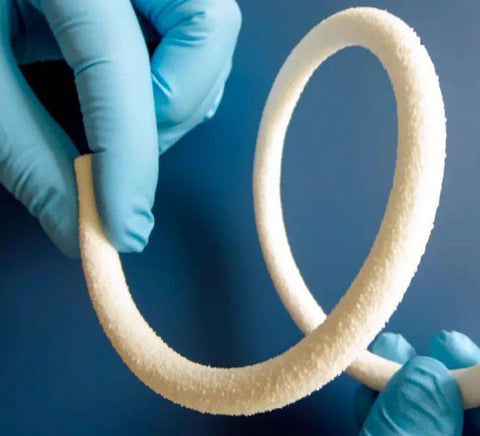
Because silk is the same protein as the keratin and collagen of the human body, the structure is very similar, so it has excellent human biocompatibility, which is a unique property that other textile fibers do not have. In order to further clarify the scientific reliability of this argument, before telling the relationship between silk and human skin, let me talk about artificial blood vessels and surgical sutures from silk. Perhaps it can be more convincing from another side. Explain the problem vigorously.
As early as 1957, China began to develop mulberry silk artificial blood vessels for clinical trials. After gradually improving and perfecting the manufacturing process, it has been able to make silk artificial blood vessels of various types and calibers to meet the needs of various types of vascular diseases. , The scope of application has been continuously expanded, and relatively good curative effects have been achieved. The successful development and clinical application of mulberry silk artificial blood vessels is a major contribution of China to the medical community.
Any kind of artificial blood vessel must have the following conditions:
- Have stable physical and chemical properties
- No foreign body reaction
- No allergic reaction
- No carcinogenic effect
- Strength and durability
- Resistant to disinfection
- Convenient manufacturing process
- After knitting, it is seamless, permeable, flexible, does not produce sharp angles, and is elastic and not easy to wither.
- However, artificial blood vessels made of synthetic chemical fibers are widely used in the world, especially polyester and polytetrafluoroethylene.
From the point of view of animal experiments, the Department of Vascular Surgery of Shanghai First Medical College has performed more than 200 experiments in which a section of the dog’s pulmonary aorta, abdominal aorta or common carotid artery and common femoral artery were removed, and mulberry silk artificial blood vessels were used. The transplantation was carried out and the visual and microscopic examinations were carried out according to the plan (the shortest 4 days, the longest 12 years), and it was found that the grafted artificial blood vessel was surrounded by a layer of intact fibrous tissue to form an outer wall, and there was a gray-white intimal growth in the cavity , Thin and smooth, similar to the intima of general blood vessels, the anastomosis is flat and smooth, the outer wall and intima are closely connected with the artificial blood vessel, and the artificial blood vessel is located in between, without any change. In other words, the silk artificial blood vessel does not repel the living body, and has grown together with the flesh and blood of the living body.
From the perspective of human clinical trials, Shanghai Zhongshan Hospital used mulberry silk artificial blood vessels to treat 152 cases of aneurysms, arteriosclerotic occlusive disease, polyarteritis, arteriovenous atrophy, arterial injury and portal hypertension, etc. The diameter of the transplanted blood vessels The maximum is 2cm, the minimum is 0.5cm, and the longest is 60cm.
- Abdominal aortic aneurysm resection, silk artificial blood vessel transplantation, the shortest is 3 months, the longest is 14 years, the average follow-up time is 53 months, the patency rate is 96.2%
- After thoracic-abdominal aortic stenosis and silk artificial blood vessel bypass grafting, 7 cases were followed up for more than 3 years, the longest was 13 years and 8 months, and the patency rate was 92%
- After extremity aneurysm resection and silk artificial blood vessel transplantation, the longest follow-up time is 18 years, and the patency rate is 70% ~ 80%
Scientists conducted experiments on animals and found that nylon fiber artificial blood vessels lost 80% of their strength after 6 months and 95% after 2 years. After using polyester artificial blood vessels for more than two years, the artificial fiber
Uses Of Silk In Food, Chemical Engineering & Biomedicine Industry
How to Make Silk From Silkworm Cocoons?
Related Posts

5 Practical Benefits of Silk Eye Masks for Sleep and Travel

Are Silk Bonnets Worth Buying? Benefits, Fit and Care

How to Choose the Best Silk Pyjamas for Australian Sleep

Silk vs Satin Sleep Mask: Which Is Best for Your Skin?

Silk Outfits for Warm Weather: Breathable Styling Guide

Best Summer Pyjamas: Cooling Fabrics for Hot Australian Nights

Types of Silk Fabric Comparison: The Ultimate Buying Guide
